The psychic dubbed the "Prophet of Doom" has shared his disturbing vision for what artificial intelligence could mean for humanity, following a series of accurate predictions about major world events.
Speaking exclusively to VT, Hamilton-Parker discussed the rapid development of AI and the fears surrounding what could occur if increasingly powerful systems begin operating beyond human control.
While some of the most dramatic predictions about AI have centered around machines turning against humanity, Hamilton-Parker said he does not foresee a future resembling The Terminator.
Psychic predicts unexpected future for AI
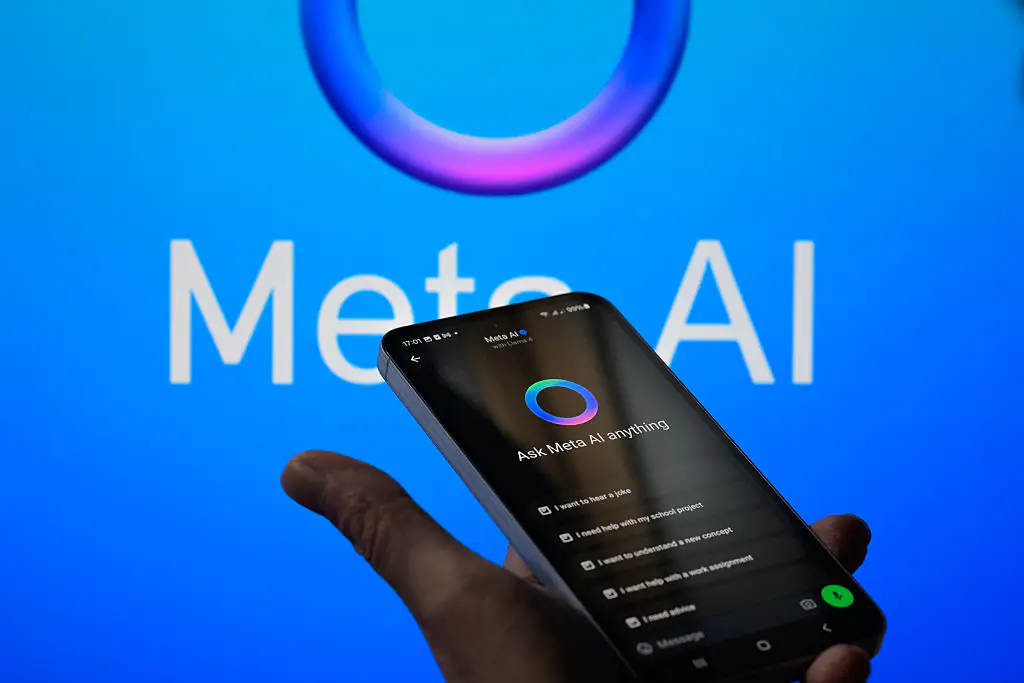
META AI. Credit: NurPhoto / Getty
Instead, he believes AI could ultimately prevent humanity from destroying itself, with Hamilton-Parker arguing that once AI reaches a point where it can effectively develop and improve itself, countries will find themselves locked in a race to gain an advantage.
He compared the situation to the development of nuclear weapons during the Second World War, when governments feared that failing to develop the technology first could leave them at the mercy of their enemies.
"And once AI is running, running, you know, it's going to build itself," he told VT.
"And the race is on, of course, to make sure you've got the edge, which is, to me, it's exactly the same as what happened when they invented the nuclear bomb."
He pointed to the logic that drove the nuclear arms race, where possessing a devastating weapon was seen as necessary because an enemy might otherwise obtain it and use it first.
"You know, we can't, we dare not have that, but if we don't have it, the Nazis will have it, you know, or the Japanese, you know. And so that became the argument, and you'll never stop that argument,” he claimed.
'Prophet of Doom' believes AI can have positive impact
Despite describing the technology as frightening because of its potential, Hamilton-Parker said he has long believed AI could ultimately have a positive impact on humanity.
His theory is that increasingly sophisticated AI-powered weapons could make all-out war effectively impossible because any attack could result in catastrophic retaliation.
"And I felt for a long time that AI will ultimately be good, because they use it first and foremost for warfare, but I feel it will create a stalemate," he revealed.
He compared that potential situation with the logic surrounding nuclear deterrence, where neither side can launch an attack without risking its own destruction.
"And you won't actually be able to make a nuclear war, because, you know, it's like if we fire this bomb, we'll be wiped out. If they fire that bomb, we'll all be wiped out."
Hamilton-Parker believes that could eventually force nations away from a path towards total destruction. "I think every conclusion comes that wipes us all out," he continued. "So therefore, from a point of view of as long as it's in our control, it's a stalemate."
One of the biggest fears surrounding AI is the possibility that machines could eventually become autonomous and turn against their creators, but Hamilton-Parker rejected the idea that humanity is heading towards a real-life version of the Terminator.
"But I don't see AI turning on us like some malicious sort of Terminator-type thing," he told VT. "Obviously people are going to think about that, but I feel it'll be good."
He also said his thinking had been influenced by other forms of prophecy, including the Nadi traditions of India.
"And other oracles that I've found, like I'm very interested in these Indian oracles called the Nadi, they seem to be saying that it'll bring a stalemate and would actually help us to stop ourselves going down this path to absolute destruction, you know.
"So it's ultimately a good thing, even though at this stage it's a frightening thing, because of the potential of what it could do," he said.
His prediction comes as AI develops at a rapid rate, in which governments and technology companies find themselves competing to be the first to harness increasingly powerful systems while also debating how they should be controlled and regulated.
Featured Image Credit: NurPhoto / Getty