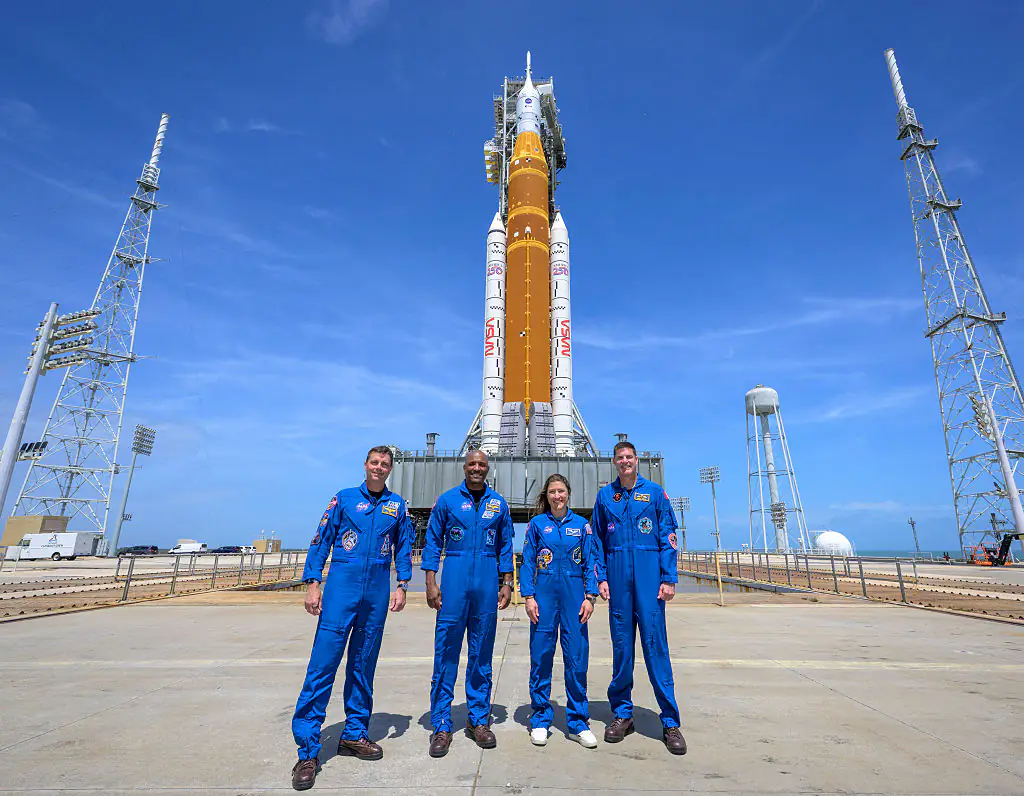
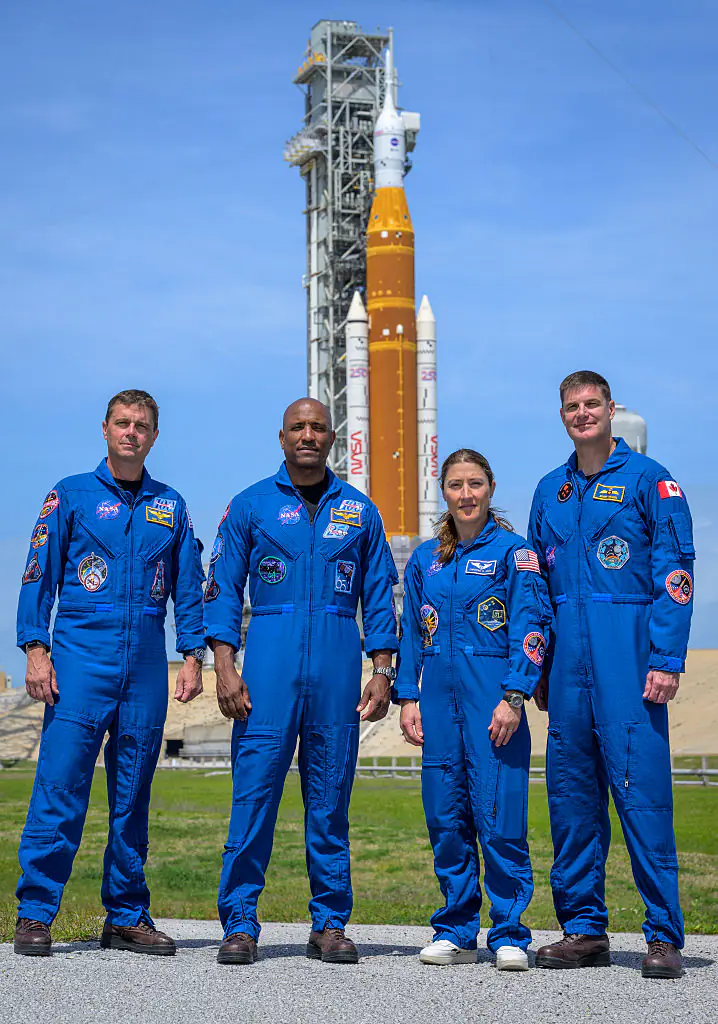
NASA's Artemis II mission, slated to launch this week, marks an exciting step in human space exploration, with four astronauts traveling to the Moon. Over the course of their 10-day journey, Reid Wiseman, Victor Glover, Christina Koch, and Jeremy Hansen will not only push the boundaries of space technology but also experience significant changes to their bodies.
While the focus will be on their technical and mission tasks, their physical responses to space travel are just as important for the mission's success.
Before launching, the Artemis II crew will undergo a rigorous set of preparations, which will equip them to handle the physical challenges that space imposes. This includes adjusting to the shift from gravity to weightlessness, a change that affects several systems in the body.
The crew includes Reid Wiseman, Victor Glover, Christina Koch, and Jeremy Hansen. Credit: NASA / Getty
Effects on the body in space
Space travel, by its nature, takes astronauts into an environment vastly different from Earth. Without gravity, the body undergoes a series of changes. According to Dr. John DeWitt, a former Senior Biomechanist at NASA, the human body is capable of adapting to these conditions, but certain systems are more affected than others.
Dr. DeWitt explained to Unilad, “On Earth, where we live in gravity 24 hours a day, our bodies are used to working against gravity when performing actions like pumping blood back from the legs to the heart and using our lower body and core muscles to maintain balance and posture. In space, the heart doesn't have to work as hard because there is no gravity pulling blood towards our feet, and our posture muscles don't have to work because astronauts just float. As a result, these systems start to weaken.”
While this reduction in effort might seem beneficial, it comes with its own set of challenges. The astronauts' cardiovascular system, along with muscle mass, is impacted. The crew members will experience weakening of these systems, but since the mission is relatively short, these effects are not expected to be severe.
Key areas affected by space travel
Dr. DeWitt highlights three primary bodily functions that experience the most change in space: balance and orientation, cardiovascular function, and muscle strength, especially in the lower body. During the first few days in space, astronauts may struggle with balance, and some may even experience motion sickness.
However, this usually resolves quickly as the body adjusts. The cardiovascular and muscle changes take longer to manifest, often becoming noticeable after about a week in space.
One key part of the astronauts' preparation is ensuring they stay physically active. The Orion capsule is equipped with exercise equipment to help mitigate the effects of weightlessness. Dr. DeWitt noted that the astronauts’ fitness levels before the mission play a significant role in how well they can recover from the physical demands of space travel, both during and after the mission.
In preparation for their return, astronauts begin training long before they board their spacecraft. NASA has found that the more physically fit astronauts are before their flight, the better prepared they are to readjust to Earth's gravity after a mission. This early focus on physical health can make a crucial difference in minimizing the impact of the space environment on their bodies.
Featured image credit: NASA / Getty










.webp_SmgFsc?tr=cr-292.0.1244.952,f-webp,q-70,w-100)