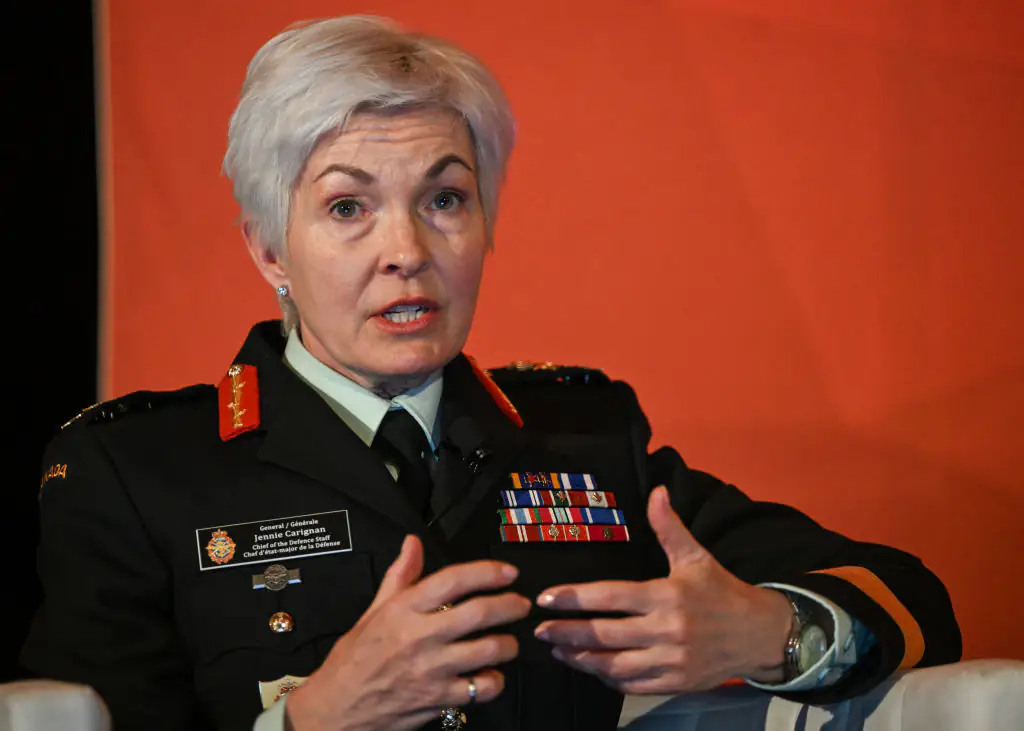
Canada’s top military leader has issued a stark warning about the global security climate, saying the world must brace for major conflicts as tensions rise across key regions.
Jennie Carignan, the first woman to lead Canada’s armed forces, spoke during a visit to London, where she met defence counterparts from the Joint Expeditionary Force. Her comments come as Canada looks to significantly expand its military capabilities in response to growing threats.
Her country is now pushing to rearm at a level not seen since the Cold War, with plans to increase full-time troops, boost reservist numbers, and recruit up to 300,000 civilians into a strategic reserve that could be called upon during a crisis.
Canada ramps up military readiness
"The world has changed," General Carignan told Sky News. "We have to get ready for large-scale conflicts, more conventional, so we need a different military to do that and different capability."
She pointed to the threat posed by hostile states such as Russia and North Korea, particularly their ability to launch long-range missiles capable of striking Canada.
Beyond that, she highlighted rising competition in the Arctic, where NATO allies, Moscow, and Beijing are all vying for influence in a region of growing strategic importance.
Canada eyes closer ties with UK-led force
A key part of Canada’s evolving defence strategy includes exploring membership in the Joint Expeditionary Force, a UK-led multinational group focused on security in the Arctic, Baltic Sea, and North Atlantic.
"We feel very, very welcome," she said. "From my perspective, JEF represents a lot of opportunities for more collaboration and again to better address some of those military challenges that we have."
The group, first conceived by the UK in 2012, includes Nordic nations and Baltic states alongside the Netherlands. Canada’s geography makes it a natural fit, and General Carignan outlined potential contributions such as "situational awareness, sharing of information, basing capabilities as well in covering that area, various types of sovereignty or operations and exercises".
Jennie Carignan, the first woman to lead Canada’s armed forces. Credit: Anadolu / Getty
Asked why Canada had not joined earlier, she explained that defence investment had been reduced between 2013 and 2014. "We have a collective of Nordic nations who are concerned more specifically by that area. So again, the situation has changed and hence now we can reconsider being part of the group."
Unlike NATO, the JEF does not require unanimous agreement to act, allowing faster and more flexible responses to emerging threats, including attacks on critical undersea infrastructure.
"The JEF allows to have that flexible option ready in support of NATO, complementary to NATO, which I think is a very positive thing from my perspective," she said.
When pressed on whether she supports joining, General Carignan added: "Yes, we are definitely interested. There's a little bit of work to do, but as I said, it looks very promising."
Breaking barriers in the military
General Carignan’s rise to the top of Canada’s armed forces also reflects wider changes within the military.
"I think I'm here today because Canada decided to remove systemic barriers in our military 40 years ago," she said.
She acknowledged the challenges she faced, adding: "Perceptions. Perceptions that women are weak, perceptions that you can't be in a combat role and be a mother at the same time.
"So those are the type of barriers that are more stereotypes than actually what the reality is. The reality of combat, the reality of serving in the military, in combat roles."
Currently, the only woman among NATO military chiefs, she expressed confidence that more will follow. "I'm sure there will be [more female military chiefs] because it's totally possible and NATO allies are removing systemic barriers as well, and it's only a question of time."
Featured image credit: Brook Mitchell - WPA Pool/Getty Images









.webp_SmgFsc?tr=cr-292.0.1244.952,f-webp,q-70,w-100)