The United States has introduced a new policy that has been approved by Congress, which will automatically give certain newborn children $1,000. The measure applies to babies born within a specific time frame and is now officially set to go ahead.
Under the plan, any child born between January 1, 2025, and December 1, 2028, qualifies to receive the $1,000 payment. Notably, this period coincides with the years of Donald Trump’s second term as president, which is expected to conclude in January 2029 after the next presidential inauguration. The program is scheduled to begin on July 4, aligning with the country's Independence Day.
Trump's 'pro-family' initiative
The initiative is part of what Trump described as his “big, beautiful bill.” He said: “This is a pro-family initiative that will help millions of Americans harness the strength of our economy to lift up the next generation. And they'll really be getting a big jump on life.”
Funds will be placed into a special account opened in the child’s name, known as a “Trump Account,” which is designed to “track the overall stock market.” Parents have the option to contribute additional money to the account to increase its value over time.
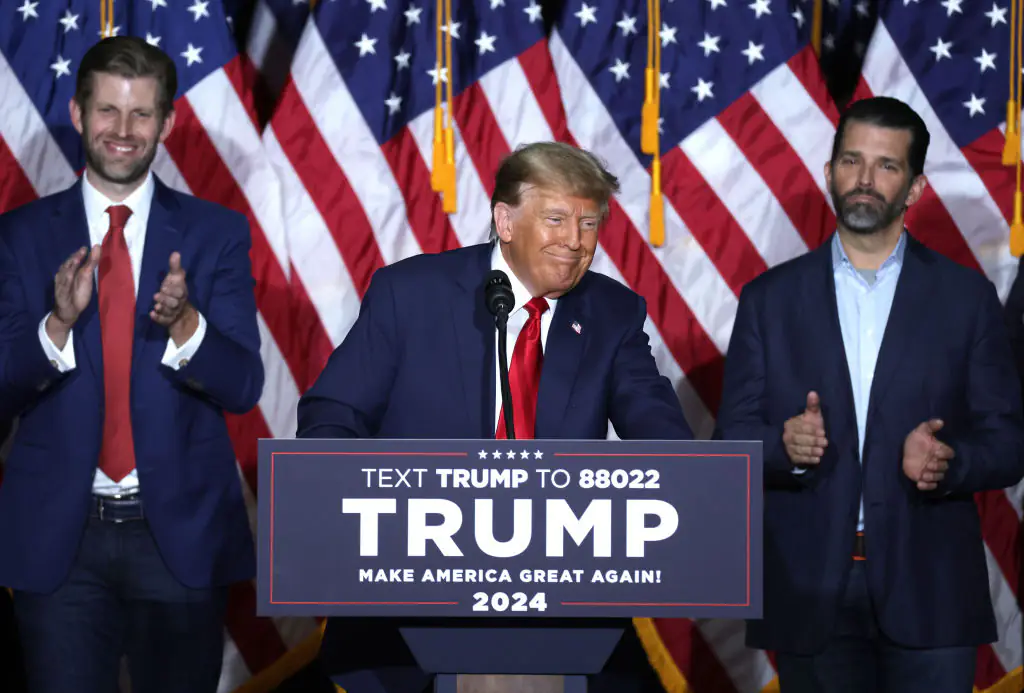
Donald Trump with sons Eric Trump and Donald Trump Jr. Credit: Alex Wong / Getty
To enroll, parents of eligible children can sign up when submitting their taxes, using IRS Form 4547 - named to reflect Trump being both the 45th and 47th president. There will also be an option to apply online through the TrumpAccounts.gov website, after which families will be notified when it’s time to activate the account.
Who qualifies for the funds under the new U.S. scheme?
The initial $1,000 comes from the US Treasury and is invested in an index fund. Each account’s value will rise or fall depending on stock market performance. Only newborns qualify for the government contribution, but parents can add up to $5,000 per year of their own money.
The funds are locked until the child turns 18. At that point, the money becomes accessible, although it does not need to be withdrawn immediately.
The scheme reportedly involves around 50 participating companies, according to Americans for Tax Reform, spanning major financial institutions, tech firms, and other organizations. Those organizations are:
- Acorns
- Anand Legacy Foundation
- Bank of America
- Bank of New York Mellon
- BlackRock
- Block, Inc.
- Broadcom
- Brownstein Hyatt Farber Schreck
- Charles Schwab Corporation
- Charter Communications
- Chime Financial Inc.
- Chipotle
- Citi
- Coinbase
- Comcast
- Continental Resources
- CTIA
- Dalio Philanthropies – Ray and Barbara Dalio
- Dell Technologies
- Delta Airlines
- Empower
- Fox Corporation
- Galaxy Digital Inc.
- Harold Hamm
- Heritage Foundation
- IBM
- Intel
- Invesco
- Invest America — Brad Gerstner (Trump Accounts inventor)
- Investment Company Institute
- JPMorgan Chase & Co.
- Kraken
- Mastercard
- Michael and Susan Dell Foundation
- News Corporation
- Nicki Minaj
- Nvidia
- Replit
- Robinhood Markets, Inc.
- Russell Investment Group, LLC
- S & P Global
- SoFi Technologies, Inc.
- Steak ‘n Shake
- State Street
- Turning Point USA
- UBER
- Vanguard
- Visa
- Wells Fargo
- ANONYMOUS DONOR, SAN FRANCISCO
Featured Image. Credit: Alex Wong / Getty