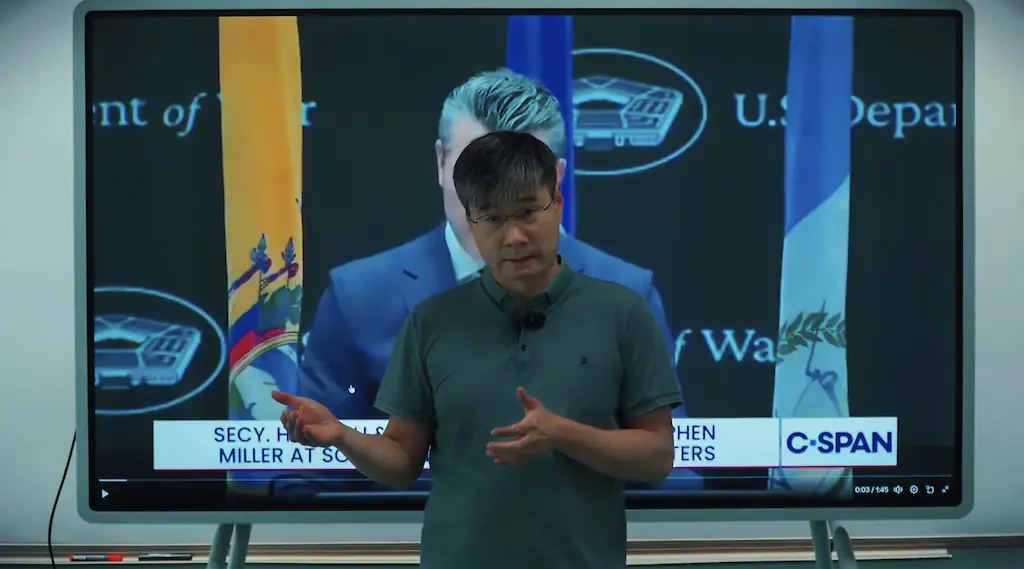
A man dubbed “China’s Nostradamus” has issued a chilling new warning about the escalating war between the United States and Iran, as tensions in the Middle East continue to rise.
Professor Xueqin Jiang, a Chinese-Canadian tutor who runs the popular YouTube channel Predictive History, has gained attention online after several of his past predictions appeared to come true.
In a viral video from May 2024, he predicted that Donald Trump would return to power and that a war with Iran would follow. He also warned that the United States would ultimately lose the conflict, “forever changing the global order.”
Now, as the situation unfolds, Jiang has shared new claims about what could come next following last week’s agreement to a temporary ceasefire.
Jiang offers chilling prediction for what may happen after ceasefire
Despite guarantees of “safe passage” through the Strait of Hormuz, the situation remains fragile, with ship traffic through the pivotal oil route having slowed considerably, with reports that vessels could be “targeted and destroyed” if they attempt to pass without Iran’s approval.
Notwithstanding the agreement, only a limited number of ships have been able to pass through the strait, raising concerns about ongoing disruption to global oil supplies.
In a video titled Trump World Order, Jiang warned that the conflict may only be getting worse. He said: “So remember, this war in Iran, it's not ending. In fact, many people believe it's only starting to ramp up.”
He also pointed to speculation about a potential ground invasion, adding: “There are rumors that Donald Trump has already authorized the use of ground forces and so we could see an invasion of Iran as early as this weekend, but certainly, definitely this month.”
China Nostradamus has given his say on what could happen after the ceasefire between the U.S. and Iran. Credit: Professor Jiang/Predictive History/YouTube
Jiang highlighted the challenges such an invasion would face, noting: “Right now America has only about 50,000 troops in the Middle East and the geography, the terrain, makes it very hard to control.”
Explaining the difficulties of a ground assault, Jiang pointed to Iran’s landscape, including the Zagros Mountains and vast deserts, which could make military operations extremely difficult.
He said: “So, you have these mountains… which allows for the Iranians to hide and conduct guerrilla warfare… Then you have the deserts… which makes it very hard to cross.”
He added that no matter which direction US forces approached from, they would face significant obstacles: “If they were to attack from Iraq, they would have to face the mountains… from Pakistan… they would have to face deserts… and from the south… you're far away from Tehran.”
A lengthy war is likely, according to Jiang
Jiang also suggested that current US actions point toward a prolonged war. He said: “Right now, the consensus seems to be that the Americans first want to control the Strait of Hormuz in order to elevate the strain on the global economy.”
He continued: “Already we're seeing lots of signs that America is preparing for a long, long war.”
Referencing reports about military readiness, he added: “So not only have they sent 50,000 troops to the Middle East, but they're preparing to call the reserves as well. So this seems as though America is preparing for total war.”
Jiang reiterated his earlier prediction that the US would lose if it launched a full-scale invasion of Iran. He said: “America would lose this war because a ground invasion would fail and the Iranians are fully prepared for a ground invasion.”
According to him, the consequences could be dramatic. He warned the “American empire would die,” adding that the US could lose its dominance in global finance and that “the global economy would collapse.”
However, Jiang also presented a more controversial idea, that such an outcome could be intentional.
He said: “What if for some strange reason, Donald Trump wants to lose his war in Iran? What if he wants the American empire to collapse?”
He argued that even a failed war could shift global dependence toward North America’s resources, explaining: “If the Strait of Hormuz is closed… the world is now much more dependent on North America and Russia for oil.”
Summing up his theory, he added: “So in other words, the United States starts a stupid war… It can't possibly win, but it still benefits.”
As tensions remain high and the ceasefire hangs in the balance, Jiang’s predictions have added to growing fears about what the future of the conflict, and the global economy, could hold.
Featured Image. Credit: Professor Jiang/Predictive History/YouTube